Localization teams
You need to determine whether Arabic narration is understandable before adapting a larger script library.
A language-focused test gives you evidence about text preparation and pronunciation instead of relying on a generic demo.
Arabic speech testing
F5 tts arabic testing is most useful when you treat pronunciation, reference audio, and checkpoint support as separate questions. Use this guide to set realistic expectations before evaluating an Arabic sample.

These pages cover adjacent ways to evaluate the model, from broader language support to reference-based voice work.
Arabic results should be treated as an evaluation question, not an automatic capability claim. The checkpoint, text normalization, and reference recording all matter.
The model name alone does not prove that every available checkpoint was trained or tuned for Arabic speech.
What to do instead
Verify the selected checkpoint with short Arabic samples before relying on it for a production voice.
Diacritics, punctuation, numerals, names, and borrowed words may be read inconsistently across samples.
What to do instead
Normalize the script, test difficult words separately, and compare undiacritized and guided versions where appropriate.
A general Arabic script does not specify whether the intended delivery is Modern Standard Arabic or a regional dialect.
What to do instead
Define the target variety first and use representative sentences rather than a generic paragraph.
A sample may be intelligible while still sounding stiff, incorrectly stressed, or mismatched to the speaker identity.
What to do instead
Score intelligibility, rhythm, emphasis, and identity as separate criteria.
Keep the first evaluation small and controlled so you can tell whether a problem comes from the text, the reference, or the model configuration.
Write a compact Arabic passage containing the names, numbers, punctuation, and pronunciation patterns that matter to your use case.
Keep the text fixed while changing only the reference audio or checkpoint, then note clarity, rhythm, speaker similarity, and repeated errors.
Listen again with a written scorecard, revise normalization or reference quality, and retest the exact lines that failed.
This comparison separates the extra checks needed for Arabic from the common steps used in any F5 TTS experiment.
| Arabic-focused evaluation | General F5 TTS evaluation | |
|---|---|---|
| Primary question | Does the selected setup produce understandable Arabic speech? | Does the setup produce the intended speech from the supplied text and reference? |
| Text preparation | Check script form, numerals, punctuation, names, and optional diacritics. | Check spelling, punctuation, segmentation, and any unusual tokens. |
| Language fit | Define Modern Standard Arabic or a specific dialect before judging quality. | Define the target language, accent, and delivery style. |
| Reference review | Prefer a clean recording with pronunciation and dialect aligned to the target. | Prefer a clean recording that represents the desired speaker identity and style. |
| Quality scoring | Score intelligibility, phoneme accuracy, rhythm, emphasis, and dialect fit separately. | Score intelligibility, naturalness, timing, and speaker similarity. |
| Failure response | Rewrite ambiguous text or test another checkpoint before concluding Arabic is unsupported. | Inspect text, reference, and configuration before changing the whole workflow. |
A useful before-and-after review compares the source material with the rendered sample while keeping the text and evaluation criteria visible.
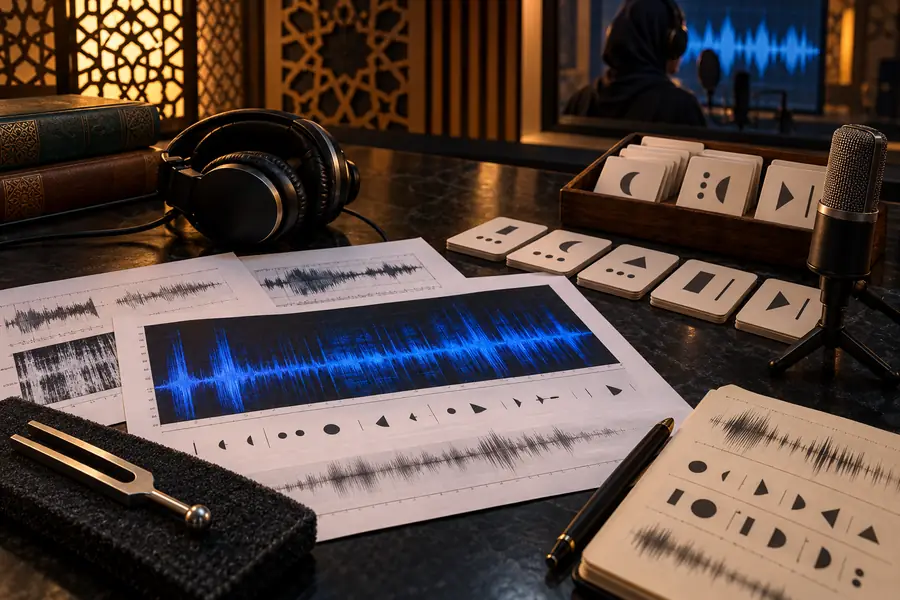

Judge pronunciation and identity separately.
Reference setupRendered sampleDifferent projects need different evidence. Choose the adjacent workflow that matches the question you are trying to answer.
You need to determine whether Arabic narration is understandable before adapting a larger script library.
A language-focused test gives you evidence about text preparation and pronunciation instead of relying on a generic demo.
You want Arabic delivery from a particular speaker reference and need to separate identity from language quality.
A reference-focused review helps reveal whether the voice match is strong even when pronunciation needs more work.
You are comparing a few short samples and need a quick way to hear whether the workflow is worth deeper testing.
A focused listening pass makes the main strengths and failure cases easier to document.
You need to reproduce an Arabic test across machines or checkpoints without changing several variables at once.
A requirements review helps you document the environment before interpreting differences in output quality.
Use a short, representative script and review the output with explicit criteria for pronunciation, rhythm, dialect fit, and speaker identity. The goal is not to assume support from the model name, but to make a clear decision from comparable samples.
Arabic output should be verified with the exact checkpoint and workflow you plan to use. The model name by itself is not enough evidence of native Arabic coverage, so test a representative script before making a production decision.
You can evaluate undiacritized text, but ambiguous words may be harder for a system to interpret consistently. Compare a small set of lines with and without useful diacritics when pronunciation accuracy matters.
Yes, dialect is an important part of the evaluation because Modern Standard Arabic and regional varieties differ in pronunciation, rhythm, and vocabulary. Define the intended variety and use examples from that variety when reviewing output.
Start with a short diagnostic script containing names, numbers, punctuation, and words that are important to your application. Keep the text fixed, then compare pronunciation, intelligibility, rhythm, and speaker similarity across runs.
Yes. A sample can be understandable while still having incorrect emphasis, awkward timing, or inconsistent treatment of names and borrowed words. Mark those issues separately so you know whether to revise the text, reference audio, or checkpoint.